
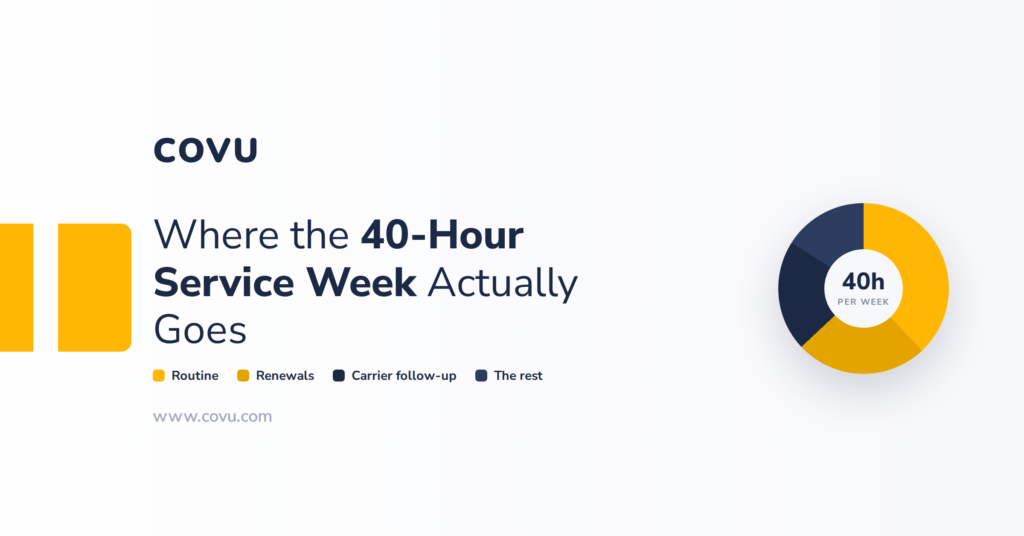
Ask an agency owner where their service team’s week goes and most cannot answer with any precision. They know the team is busy. They know the week fills up. What they cannot see is how those 40 hours actually break down, and that blind spot is exactly why insurance back office outsourcing is so hard to evaluate: you cannot offload what you have never measured. This piece walks through where a typical P&C service week actually goes, task by task, so the drag becomes visible.
None of the work below is optional. It all has to happen. The question is whether it has to happen the way it happens now, on the desks it currently sits on, at the cost it currently carries.
The hours nobody tracks
A service week is not spent on one thing. It is spent on dozens of small things that never get logged against the clock. Ten minutes chasing a carrier for a response. Fifteen re-keying data that already lived in the AMS. Twenty pulling together a certificate that a client needed an hour ago. Individually, none of it looks like a problem. Added up across a week and a team, it is most of the week.
This is the core reason service feels heavier than headcount should allow. The visible work, the renewals and the endorsements, sits on top of a layer of invisible coordination: following up, re-checking, waiting, re-entering. That coordination layer is where the hours go, and it is the first thing a serious look at insurance operations has to account for.
Certificates, endorsements, and the routine grind
Start with the highest-frequency tasks. Certificate requests, basic endorsements, ID cards, billing questions. Each one is quick in isolation. In volume they dominate the week, and they almost always land on licensed, experienced staff who do not need to be the ones doing them.
This is the clearest case for change, whether through automation or partner capacity. Routine, rule-based, high-volume work is exactly what insurance bpo services and automation handle well, at a fraction of the per-task cost of an experienced CSR. Moving it off the team does not reduce service quality. It frees the people who were doing it to spend the week on work that actually needs their license and judgment.
Renewals and remarketing: the quarter that eats itself
Renewals are the seasonal spike every agency knows and few staff for well. Preparation, remarketing, carrier submissions, and client conversations cluster into renewal-heavy weeks that overwhelm a team sized for the average, not the peak. So the team works late, turnaround slips on everything else, and the quality of the renewal conversation, the part that actually retains the client, suffers.
The trap is hiring for the peak. Carry that capacity year-round and service cost climbs and never falls back. This is where outsourcing insurance service work as variable capacity fits: licensed help that absorbs the renewal surge and scales back afterward, so the peak does not force a permanent hire. Handled well, insurance agency outsourcing turns the renewal quarter from a fire drill into a managed flow.
Carrier follow-up and the coordination tax
Then there is the work that is pure friction: chasing carriers for responses, following up on submissions, checking on the status of something that should have closed days ago. It produces nothing on its own, but it consumes hours, and it is stressful in a way that quietly wears a team down.
Most of this coordination tax is a symptom of undefined process and scattered ownership. When follow-up is nobody’s documented job, it becomes everybody’s interrupt. Structured insurance back office services put that coordination into a defined flow with clear ownership and a record of what is outstanding, which is how the tax comes down. It is unglamorous work, and it is precisely the kind of thing an operating partner should own end to end.
| Where the week goes | Why it drags | The fix |
|---|---|---|
| Routine high-volume tasks (certificates, endorsements, ID cards, billing) | Lands on licensed, experienced staff who do not need to do it | Automation or licensed partner capacity |
| Renewals & remarketing | Seasonal surge overwhelms a team sized for the average, not the peak | Variable capacity that absorbs the surge and scales back after |
| Carrier follow-up (the coordination tax) | Produces nothing, has no clear owner, and wears the team down | A defined flow with clear ownership and a record of what is outstanding |
What the week could look like instead
Add the pieces up and the picture is clear. A meaningful share of a P&C service week goes to routine tasks that do not need experienced staff, renewal surges that overwhelm a team sized for the average, and carrier coordination that produces nothing but consumes hours. That is not a reflection of a lazy team. It is a reflection of an operating model that was never designed, just accumulated.
A redesigned week looks different. Routine work runs on automation and licensed partner capacity. Surges are absorbed by variable capacity instead of permanent hires. Coordination sits in a defined flow with clear ownership. What is left for the in-house team is the judgment-heavy, relationship-heavy work that actually grows the book. That is what COVU is built to deliver: licensed U.S.-based teams running the service work inside your AMS, so the week finally goes where it should. COVU has operated 50+ insurance agencies over the years and managed $200M+ in premium across the portfolio, and S&G Mitchell moved from 17.9% to 60%+ EBITDA in 12 months on the same book by changing the operating model, not the customers.
GET YOUR SERVICE WEEK BACK
Book a Service Consult
See where your service week is going and what could move off it.
See COVU Services
What COVU takes off your team’s plate, and how.
Agency Resources
Guides and tools for independent P&C operators.
Frequently Asked Questions
Where does a P&C agency’s service week actually go?
Mostly to high-frequency routine tasks (certificates, basic endorsements, billing questions), seasonal renewal and remarketing surges, and carrier follow-up. Much of it is invisible coordination work that never gets logged, which is why service feels heavier than headcount seems to justify.
What is insurance back office outsourcing?
It is handing the service and back office workload (certificates, endorsements, renewals, carrier follow-up, data entry) to a licensed external partner that works inside your systems. Done well, it is genuine licensed capacity, not a call center, and the agency keeps its clients, carriers, and book.
What is the difference between insurance BPO services and a virtual assistant?
Insurance bpo services provide a managed team that takes accountability for defined outcomes and can handle licensed work. A virtual assistant takes individual tasks and hands the accountability back to you. The difference matters most on regulated work and at volume.
Does outsourcing service work reduce service quality?
Not when it is structured correctly. Moving routine work to automation and licensed partner capacity frees experienced staff for the judgment and relationship work that actually drives quality. The risk comes from unlicensed, disconnected providers, which is why licensing and AMS integration matter.
When should an agency consider insurance agency outsourcing?
When routine tasks are consuming experienced staff time, when renewal surges force overtime or a permanent hire, or when carrier coordination is eating hours with no clear owner. Those are the signals that the week is being spent on work a partner could take.