

An independent agency’s strength is choice. You represent many carriers, so you can place each client with the right one. That same strength is what makes the workday heavy, because every carrier comes with its own portal, its own login, and its own form. BEX, the new insurance agency browser extension from COVU, was built to take that weight off your team.
BEX is COVU’s in-browser assistant. It runs inside the carrier portals and the agency management system your team already uses, moves a full customer case between them in a single click, answers carrier questions in the side panel, and shows you where your service hours actually go. This post covers the problem it solves, where it fits in the COVU operating stack, and what it does, capability by capability.
The problem: every carrier portal is its own island
Picture one service request. A client wants to add a vehicle. Simple on paper.
The rep opens the account in the agency management system, then opens the carrier’s portal in a new tab. The portal wants a login, and the login wants a two-factor code. The rep searches for the policy by number, which means tabbing back to copy that number, then tabbing forward to paste it. The policy loads. The rep reads the screen, adds the vehicle, and types the driver and garaging details that already exist in the management system, because the portal does not know about them. When the work is done, it reverses, because the carrier confirmation has to go back into the management system so the record matches.
That is one request. A busy desk runs dozens a day, across many carriers, and each step repeats. The friction is not any single click. It is the repetition and the spread.
- Logins everywhere. A service team juggles dozens of carrier sites plus the management system, billing, email, e-signature, and a password manager. Switching carriers or agencies means another login, often another two-factor code.
- The same facts, typed over and over. Name, date of birth, address, policy number, vehicle, and coverages get re-keyed across portal after portal, and back into the management system.
- Copy and paste is the actual job. Much of the day is small copy-and-paste actions between systems. They are tiny, they happen thousands of times, and they are where errors start. One transposed policy number becomes a rework, a callback, and an unhappy client.
- It is invisible. None of this shows up in management-system reporting, because the work happens between the systems, not inside any one of them.
This is why service feels like it never ends, and why the cost is so hard to pin down. The team is not slow. The workflow is.
Where BEX fits: the COVU operating stack
To understand BEX, it helps to see the whole. COVU runs as an operating stack, a connected set of modules that take agency service work from raw inbound to finished, measured outcome.
- COVU Connect is the data plane. It consolidates your book across agency management systems, cleans it up, and keeps one trusted record, so everything downstream works from the same source of truth.
- COVU OS is the control plane. It captures every request as structured work, decomposes it into tasks, routes each task by license and skill, and measures what each one costs in time, quality, and speed.
- COVU Service Network is the supply layer. It is additional capacity, licensed and unlicensed people plus AI, that can plug into your team when you want it. Your staff is always your staff. The Network is extra capacity, not a replacement.
Vero is COVU’s AI, used across the stack rather than living in any one module. And BEX, COVU’s in-browser assistant, is the newest feature of COVU OS. It is the browser extension that brings the operating stack to where your team already works, surfacing the right case, the right next step, and Vero’s help inside the carrier portals and management-system screens they touch all day. You can run it on its own or alongside the rest of the stack.
In other words, the operating stack does the heavy lifting underneath, and BEX is the surface your agents touch. Here is what that surface does.
Super Paste: the whole case in one click
BEX captures the customer’s case once, from the source of truth in COVU OS, and then carries it everywhere the team works. The capability your team feels first is Super Paste.
Open an account in COVU OS, click copy, then paste on the destination. The insured name, policy number, address, dates, and coverage detail drop straight into the carrier’s fields. The vehicle add from earlier collapses from a five-minute scramble into a click and a quick review.
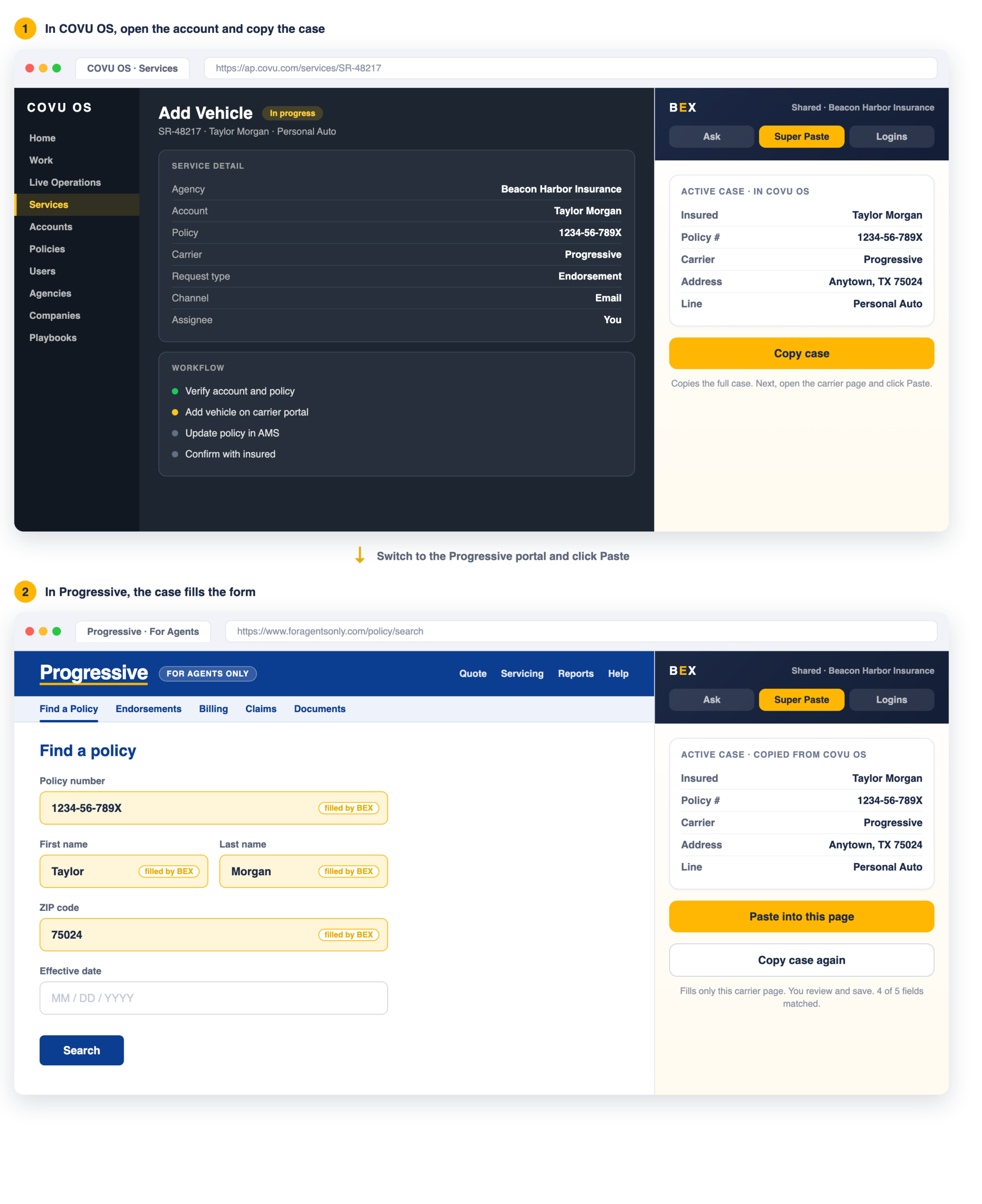
Super Paste runs in both directions, which matters more than it first sounds:
- COVU OS to a carrier site covers quoting, reshopping, and policy lookups.
- A carrier page or PDF back to COVU OS covers the other half of the day, the part where reps used to hand-copy carrier confirmations into the service record. Because the data is already in COVU OS, there is nothing to scrape and nothing to re-key.
| Direction | What it does | When a team uses it |
|---|---|---|
| COVU OS to carrier | Fills the carrier’s form from the active COVU OS case | Quoting, reshopping, looking up a policy on the carrier site |
| Carrier or PDF to COVU OS | Fills the COVU OS service or policy form from carrier data already in COVU OS | Closing the loop after carrier work, building the record |
It fills a real spread of fields: insured details, contact, full and parsed address, the policy block, and the first vehicle and driver for auto, with dates and phone numbers reformatted to whatever each carrier expects. It works across a growing list of carrier portals, and inside the major management systems COVU integrates with, including Applied Epic, AMS360, NowCerts, Sagitta, QQCatalyst, and EZLynx.
When a portal is not custom-mapped yet, a Smart Paste fallback matches fields by their on-screen labels and fills the common ones, so the page does something useful instead of nothing.
Coverage that grows itself
A fixed list of carriers would not survive contact with a real book, because every agency writes a different mix. So BEX learns.
When the team lands on a carrier form BEX does not fully map yet, it records only the structure of that form, the field labels and the layout, with the insured’s values stripped out. That signal shows which carriers and fields agents hit most, and those become the next maps shipped. The more your team pastes, the more carriers BEX learns to fill.
Privacy is built into that loop. Paste and capture only ever fire on carrier and management-system pages, never on unrelated sites, and the learning step never captures an insured’s data, only the shape of the form.
Ask Vero, without leaving the page
The questions that interrupt service work do not need a phone call or a hunt through a guide. Vero, COVU’s AI, lives right in the BEX side panel.
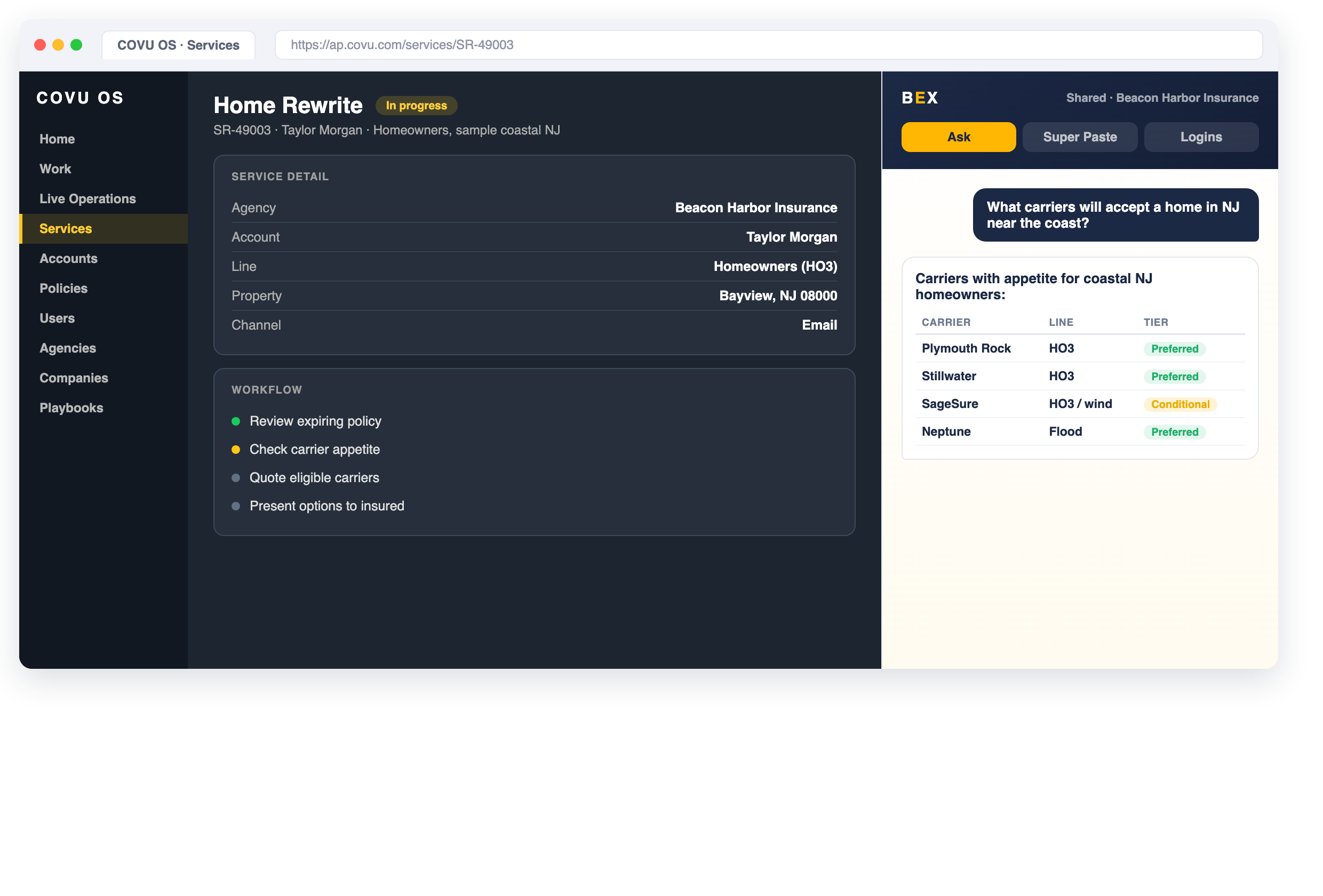
Ask about carrier appetite, eligibility, or underwriting, and Vero answers in clean tables and lists. Ask which carriers will accept a home in a given state with a given profile, and you get a carrier, line, tier, and notes table in the flow of the work. The lookup that used to break a rep’s focus now happens where they already are.
Insights: see where the service hours go
Because BEX runs in the browser, it sees the whole service trip, not just what happens inside the management system. It turns that activity into the visibility COVU OS is built to provide, in four buckets:
- Operating telemetry at the task level: cost, quality, speed, and compliance.
- Workforce visibility: roster, availability, and skill or license coverage against capacity.
- Book performance: retention by line and carrier, growth, and at-risk customers.
- Time and effort by carrier: how much time the team spends in each portal, and whether that effort is turning into finished work.
This is the part the agency management system never gave you, and it arrives as a byproduct of the work rather than as another report someone has to fill in.
A preview of what BEX reveals
In one recent week of service activity across multiple mid-sized agencies, the data was striking:
- About 44% of completed service tasks are already handled by AI, up from zero before launch.
- The same task can cost close to ten times more on one carrier’s portal than another, once you measure time against work actually completed.
- Every person runs roughly 185 manual copy-and-paste actions a day, most of them only about 17 characters long, just moving policy numbers and names between systems.
- Under 60% of the day is spent in systems of record. Each person loses close to two hours a day to email and meetings, and about 20 minutes just logging in.
These are the patterns BEX surfaces automatically, and they are exactly the ones standard reporting hides. We pulled a full week of this data into a short report, Where Your Service Hours Actually Go, so you can see the whole picture and how your own agency would compare.
Built for control, and enabled piece by piece
A tool that fills forms and reads activity has to earn trust, so BEX keeps your team in control at every step. It stays hidden until someone opens the panel. It never fills anything on its own. A rep clicks copy, then clicks paste, and then reviews and saves the result, exactly as they would with their own typing, only faster. It acts only on carrier and management-system pages.
You also do not have to adopt all of it at once. Each capability can be enabled on its own. An agency drowning in re-keying can start with Super Paste. An owner who wants to understand the operation before changing anything can start with Insights. You match BEX to how your team works, not the other way around.
| Capability | Best first step for |
|---|---|
| Super Paste | Teams losing the most time to re-keying and tab-hopping across portals |
| Self-learning coverage | Agencies writing a wide or unusual carrier mix |
| Ask Vero | Teams that field a lot of appetite and eligibility questions |
| Insights | Owners and managers who want to see where service hours go before changing anything |
Why it works, and how to start
BEX is not a prototype. It is the same operating stack COVU uses to run service for the agencies it operates. COVU has operated more than 50 insurance agencies over the years, managed over $200M in premium, and served more than 500,000 customers, and it integrates with 8 agency management systems today. The improvements your team gets are the ones our own desks demanded first, which is why the product keeps getting better every week.
Installation is a browser add, not an IT project. Your team keeps their logins, their management system, and their carrier portals, and BEX layers on top.
If you have ever looked at your service costs and wondered where the hours go, BEX is the fastest way to find out, and the fastest way to start getting some of them back.
Learn More About BEX
Insights from BEX
Read the full data report on where agency service hours actually go, and how your own agency would compare.
COVU Operating Stack
Learn more about the COVU operating stack and book a demo to see it live.