
By Tooraj Helmi, Senior Director of Engineering, COVU
Operational transformation is the redesign of work itself into discrete units that can be routed to whichever agent, human or AI, executes them best
As AI begins to rival human efficiency, a company’s edge no longer comes from whether it runs digitally. Digital transformation is dead. The question now is how a company organizes its operations so that they can be run by AI and human agents together, without friction, and in the most efficient way possible.
At COVU, a pioneering insurtech startup, we’ve learned to reshape insurance requests around finite units of work, each requiring a specific skillset and producing a specific outcome. A request that used to be one undifferentiated task handled end-to-end by a person becomes a sequence of well-defined units: some that demand licensed human judgment, some that are pure data retrieval, some that are synthesis or drafting. Once work is shaped this way, each unit can be routed to whichever agent, human or AI, handles it best. That routing is the transformation. The AI is incidental; the restructuring of the work is the point.
In management consulting, the phrase has long described reengineering operations for efficiency, usually one chapter of a larger digital-transformation program. We mean something more specific by it: not making people leaner at the work they already do, but redesigning the work itself so human and AI agents can run it together, each routed to the units they handle best.
Why most AI adoption fails
The biggest pitfall for companies chasing AI-driven efficiency is to open an account with a frontier-model provider and burn thousands of dollars a day on tokens, and call that a strategy.
Here’s what we’ve seen happen instead. Employees feel an early boost in efficiency, but the organization rarely sees positive ROI, because the operations themselves never change. The only thing that changes is how individuals do their existing tasks: it improves in the short run, plateaus in the mid run, and degrades over the long run.
Take developers. They write more code at first, compressing feature development tenfold. But over time the black-box syndrome sets in. They lose touch with how things are built. They lose the ability to make sound high-level design decisions or to keep the system well-organized. AI compounds the small, hidden mistakes made early on, and eventually the codebase becomes a giant, overinflated balloon that no one understands or can fix. The same dynamic plays out with executives using AI to strategize and product teams using it to design.
Given the cost of tokens, companies eventually find themselves with negative ROI, and, worse, a workforce whose creativity has been hollowed out. This is the part worth slowing down on, because it’s the hinge the whole solution turns on. Naive adoption hands the whole task to AI, including the parts that demand creativity and design, the architecture decisions, the strategy, the judgment calls, and leaves humans supervising execution they no longer understand. It points AI at exactly the part of the work humans should have kept, and keeps humans on the part AI could have handled. The dependence that follows isn’t a side effect; it’s the predictable result of misallocating the work.
The reason naive adoption fails is therefore simple: pointing AI at unchanged work just lets people do the same tasks faster, until the loss of understanding catches up with them. Nothing about the operation has actually been transformed, and the one thing that should have been protected, human creativity, is the first thing consumed.
The right way: treat it as a resource-planning problem
So what’s the right way to build on top of AI? It’s what we call operational transformation, and the key is to recognize that AI agents and human agents are both just agents in a resource-planning problem.
From an economic standpoint, this reframes the entire problem. Human and AI agents match on two dimensions and split on two. Both are simply agents that execute units of work, and both are only efficient on a small, well-defined unit of work. Where they differ is scarcity and cost: human specialists are scarce and expensive, while AI is effectively unlimited and cheap.
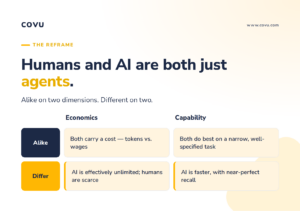
Classic resource planning is built entirely around the scarcity difference: a limited pool of specialists, and the whole game is allocating them across competing demands. AI erases that constraint. It’s effectively unlimited, so scarcity stops being the thing to optimize around. But the shared trait on capability is the catch: an abundant agent is only efficient on a small, well-defined unit of work. So the problem flips, from “how do we ration scarce specialists” to “how do we decompose work into units small enough that an abundant agent can execute each one well.”
That decomposition is the entire discipline. Get the units right, and routing becomes almost mechanical.
Some tasks still require humans, for two reasons. First, and this is the exact inversion of the failure mode above, human creativity still outweighs AI’s on complex, multi-dimensional problems, so the creative and design-level work is precisely what you route to humans rather than away from them. Naive adoption let AI consume that creativity; operational transformation concentrates it where it counts. Second is accountability: some work demands a license or regulatory standing only a human can hold. AI can draft the recommendation, but it can’t be the one to stand behind it. Consistency cuts the same way: AI is steadier than any person, but when it’s wrong it tends to be confidently wrong, so a human stays at the seams to catch what would otherwise ship.
What this looks like in practice
Take a policy renewal, the workhorse of personal-lines servicing, and a good test precisely because it’s long, recurring, and historically expensive.
Run the old way, a renewal is one continuous job a licensed agent owns from end to end. Weeks out, they pull the expiring policy, review the coverage and any claims activity, re-rate it, shop it across carriers to see who will write it and at what price, decide whether to recommend a change, draft the outreach, call the customer, and bind whatever they land on. An hour or more of a licensed professional’s time per policy, and on a book of thousands, that hour is the constraint the whole agency runs into.
Now look at what each part of that job actually requires:
- Identification. Surface the policy 90 days before expiration, with its renewal signals and retention risk. A scheduled trigger reading the policy journal, the engine. No human at all.
- Data assembly. Pull current coverage, premium history, loss runs, and the customer’s other policies into one place. Pure retrieval, AI.
- Remarketing. Run the risk through a comparative rater across carriers and check carrier appetite to see who will actually write it. Mechanical, high-volume lookup, AI.
- Advisory draft. Assemble the renewal readout: coverage gaps, cross-sell openings, reshop signals, a recommended option. Synthesis from the assembled data, AI.
- The coverage recommendation. Decide what to actually advise the customer, raise this limit, move to that carrier, drop this rider, and stand behind it. Advising a client on coverage and recommending a replacement is a liability-bearing act that requires a P&C license. This unit, and only this unit, needs the licensed agent.
- Outreach and follow-up. Send the renewal email, book the call, chase the non-responses. AI, or a cheaper unlicensed coordinator.
- Processing. Once the customer agrees, enter the change, handle the paperwork, confirm the bind. Execution against a decision already made, AI or a cheaper human, under the agent’s authority.
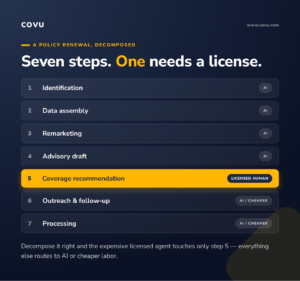
Seven steps; one of them needs a license. Run end-to-end by a single licensed person, the most expensive resource in the building is occupied for the full hour, most of it spent on data entry and carrier lookups that demand no license at all. Decomposed correctly, that agent is pulled in for step 5, minutes, not an hour, and everything on either side of it routes to AI or to cheaper unlicensed labor. That is the economic argument made concrete, and it follows directly from treating agents as a resource-planning problem: your scarcest, most expensive agent has the highest hourly cost, so the entire game is to spend that cost only on the judgment the license actually exists to cover, and to push everything else onto agents that are abundant and cheap.
The artifact that makes this hold together is the playbook: it names the seven units, marks step 5 as license-required so the router will never hand it to anyone else, and wires the proactive trigger that starts the whole sequence at 90 days without a customer ever calling. Because the decomposition lives in the playbook rather than in a veteran agent’s head, it can branch on conditions, be versioned and improved deliberately, and run identically across the entire book. Change the decomposition once, and every renewal runs the new way.
Notice where the human ended up. The licensed agent didn’t get faster at doing renewals; they stopped doing most of a renewal at all. They now own the one unit the law reserves for them, plus the design of the playbook that governs all the others.
Why this avoids the atrophy trap
This is also the answer to the obvious objection: if naive AI adoption causes skill atrophy and dependence, why wouldn’t operational transformation cause the same?
The difference is where humans sit in the system. In naive adoption, the human hands an entire task to AI and slowly loses the thread of how it’s done. In operational transformation, humans own the unit boundaries, the design of how work is decomposed, and the synthesis and judgment at the seams between units. They stay accountable for the high-level structure precisely because that’s the part AI can’t be trusted to hold together. The atrophy happens when AI absorbs the design of the work. Operational transformation keeps that design firmly in human hands, the playbook, and the licensed judgment at its core, and routes only the well-specified execution.
That’s the shift. Operational transformation isn’t about making operations digital, and it isn’t about making them faster. It’s about making them routable, between humans and machines, for the first time.