
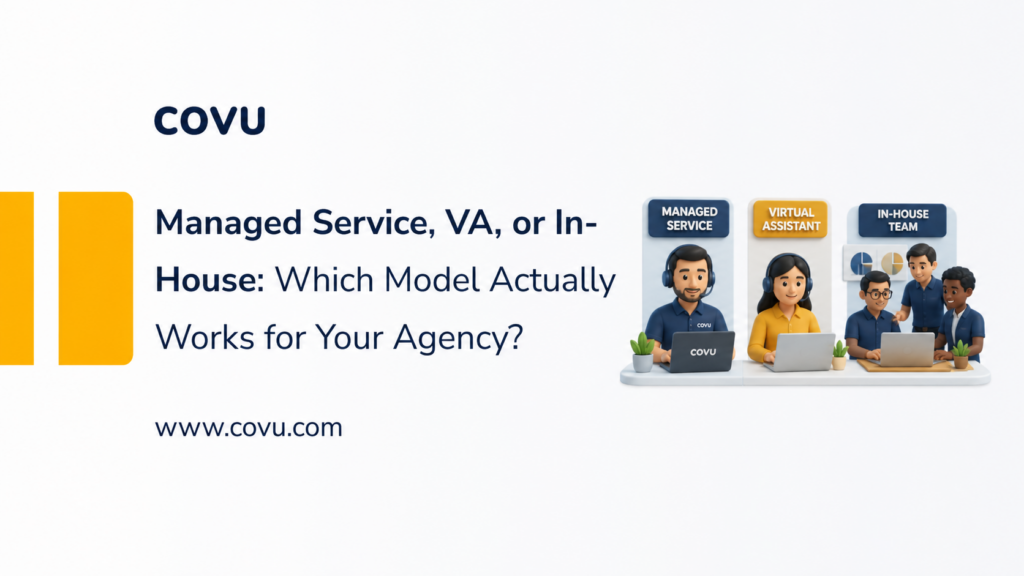
Every agency owner who’s tried insurance back office outsourcing eventually hits the same wall: the options don’t actually work the same way, even when they’re marketed like they do. A virtual assistant, an outsourcing provider, and a managed service are three fundamentally different operating models. Choosing the wrong one doesn’t just waste money — it creates a different kind of operational drag than the one you were trying to solve.
Here’s what the differences actually mean for a working P&C agency.
What “Outsourcing” Really Means for an Insurance Agency
Outsourcing insurance operations isn’t a single thing. The label gets applied to everything from a freelancer handling data entry in the Philippines to a fully integrated service partner managing your entire book’s renewals pipeline. Understanding what you’re actually buying matters before you sign anything.
The global insurance outsourcing market reached $7.2 billion in 2024 and is growing at a 5.4% CAGR through 2034, according to GM Insights. That growth reflects agencies shifting from pure cost-cutting toward something more strategic: offloading work that doesn’t require a licensed producer while keeping your best people focused on clients and new business.
Three models dominate the market for independent P&C agencies. Each has a different ownership model, a different accountability structure, and a different ceiling on what it can actually deliver.
What a Virtual Assistant Brings to the Table
A VA is a person — typically one person — who handles tasks you assign them. They work on your AMS, follow your SOPs, respond to your instructions. At their best, a trained insurance VA can cover endorsements processing, COI issuance, data entry, renewal follow-ups, and basic carrier communications without adding to your headcount overhead.
The model works when: you have clear SOPs, someone in-house to manage the VA’s workload and quality, and task volume that maps to roughly one full-time person. It breaks down when the VA gets sick, leaves, goes on vacation, or encounters a problem that requires judgment beyond their training. You’ve effectively hired one person with a lower price tag. The operational risk profile is essentially the same.
VAs make sense for agencies that need to offload repetitive volume without committing to a more structured engagement — especially when internal SOPs are already documented and someone on the team can manage the relationship. The tradeoff is that management overhead stays with the agency owner.
What an Outsourcing Provider Actually Delivers
A third-party outsourcing provider brings an entire team and infrastructure to handle specific workflow categories. They take a defined set of processes off your plate and run them according to agreed service levels. Claims processing, underwriting support, policy administration, document management: these get handed off to a specialized team with their own QA process, redundancy, and technology stack.
The distinction from a VA is accountability. An outsourcing provider owns a process outcome, not just task completion. If your renewal team turns over, that’s their problem to solve. If SLAs slip, that’s a contractual issue — not a management conversation you’re having internally.
The limitation: most outsourcing providers are built for high-volume, highly standardized operations. They work best when your workflows are clean enough to hand over without significant customization. Many agencies find them either too rigid to adapt to their specific carrier mix, AMS workflows, and service standards — or priced for an operational scale they haven’t reached yet.
How a Managed Service Model Is Different
A managed service is not a staffing arrangement and not a task-delegation model. It’s an operational partnership where an external team takes functional ownership of a defined area of your agency’s operations — and is accountable for the results, not just the activity.
With COVU’s insurance administrative services, the team integrates directly into your agency’s workflows, operates inside your AMS, and handles the full policy servicing cycle — from endorsements and renewals to carrier follow-up and COI processing. There’s no “assign it and hope” dynamic. There are defined outcomes, ongoing communication loops, and a team built around your book specifically.
The structural difference: a VA works for you task by task. An outsourcing provider runs a defined process. A managed service partner runs a function — and owns the results that function produces.
The Hidden Cost of Keeping Insurance Administrative Services In-House
Many agency owners default to in-house because it feels controllable. But the real cost of keeping insurance administrative services in-house is rarely visible in a single line item.
A licensed account manager earning $65,000–$85,000 annually who spends 40% of their time on administrative tasks is effectively costing the agency $26,000–$34,000 per year in misallocated labor — for work that generates zero direct revenue. Multiply that across your service team and the number compounds fast into productivity that isn’t going toward client relationships or growth.
Then add recruiting, training, turnover, benefits, and E&O exposure from manual process errors. The fully loaded cost of in-house back office work almost always exceeds what it looks like on a salary budget line.
What to Actually Compare When Evaluating Your Options
When evaluating insurance agency outsourcing options, the right comparison isn’t cost per hour — it’s cost per outcome with risk factored in.
VAs: Lower cost, but management overhead stays with the agency. Suitable for stable task volume with strong internal SOPs.
Outsourcing providers: Higher accountability on defined processes, but often built for high-volume, highly standardized operations. Watch for generic workflows that don’t match your carrier mix.
Managed services: Highest integration and accountability. Best fit for agencies that want to fully offload a function rather than manage a person or vendor.
The agencies that see the clearest operational improvement are the ones who match the model to what they’re actually trying to solve. If the problem is “I need someone to do tasks,” a VA might work. If the problem is “I need my service work to run without me managing it,” that’s a managed service conversation.
Is Insurance Back Office Outsourcing Right for Your Agency?
The question isn’t whether to outsource. For most independent P&C agencies, the question is when and in what form.
If your account managers are spending more time on policy administration than on client relationships, you’re already paying the cost — just internally. If you’re losing nights and weekends to service work that shouldn’t require a principal’s attention, the model you have isn’t working. If one departure on your service team would meaningfully disrupt your book, you have a concentration risk that outsourcing insurance operations can eliminate.
COVU works with agencies at multiple stages of this decision. Whether you’re exploring how to offload specific workflows or looking to restructure your entire service operation, the right place to start is understanding what’s actually consuming your team’s capacity.
Talk to the COVU team about how a managed service approach might work for your agency.
